Land and People
Hawai`i conservationist and artist Melissa Chimera and University of Hawai`i Mānoa fire and ecosystems scientist Dr. Clay Trauernicht talk with land protectors in Hawai`i and the Pacific about the places they cherish through their professional and ancestral ties. We paint an intimate portrait of today’s land stewards dealing with global crises while problem solving at the local level. Brought to you by the Cooperative Extension Program at the University of Hawai`i at Mānoa’s College of Tropical Agriculture and Human Resources. Music ”Raindrops” courtesy Lobo Loco and ”Bale Wengei” courtesy Joshua Rostron.
Listen on:







Episodes
Friday Oct 10, 2025
Friday Oct 10, 2025
In this interview, co-hosts Melissa Chimera, Clay Trauernicht and University of Hawaiʻi at Mānoa art professor Dr. Jaimey Faris explore how their respective fields in art and science critically examine the social and political paradigms that separate humans from each other and the world around us. They trade perspectives on what a sustainable and a thriving future might look like for all living beings—as manifested in the present day struggles for indigenous sovereignty and liberation from Lahaina to Papua New Guinea and Palestine. Clay and Jaimey talk about their respective upbringings in New York and California amidst economic and social class disparities and how that led them to engage with the underrepresented from all over the world—from kanaka maoli in Hawaiʻi striving for access to water to Mexican women manufacturing goods—via their respective fields of fire science and art.
Friday Sep 26, 2025
Friday Sep 26, 2025
Noelle MKY Kahanu is a bridge builder across art, policy and social justice through her work as a museum curator, legal scholar, Hawaiian rights activist, and teacher. She is a University of Hawaiʻi Specialist and Interim Director for Museum Studies Graduate Certificate Program, having worked for fifteen years previously as a curator and program lead for the Bishop Museum. Noelle tells us of traversing the many worlds of art and activism, beginning in her youth with close family and friends who were involved in class struggles. In this interview, Noelle speaks to a lifetime of "heart work" that combines deep empathy, fortitude and analytical skills–from repatriating Hawaiian human remains to ethnographic and contemporary art exhibitions around radical renewal and healing among often overlooked communities.
Friday Sep 12, 2025
Friday Sep 12, 2025
Dr. Ty Tengan is a professor in the Department of Anthropology at University of Hawaiʻi at Mānoa whose work emphasizes ethnic studies in relation to Hawaiian identity and masculinity, sovereignty, land, and militarism. His activism and work extends to running oral history field schools, cultural workshops, water rights and burial site protection. In this conversation, Melissa and Clay talk about Tenganʻs work in native Hawaiian repatriation, and the profound significance of ʻiwi kupuna burial practices perpetuating indigenous worldview. We discuss the “forced amnesia” of colonization and the re-learning and re-membering Hawaiian traditions and practices, especially those around Hawaiian masculinity.
Friday Aug 29, 2025
Friday Aug 29, 2025
We continue our two-part conversation with Dr. Ross Cordy, Pacific Island Hawaiian-Pacific studies at University of Hawai‘i West O‘ahu. Trained as both an archaeologist and ethnohistorian, Dr. Cordy’s specialty is reconstructing the history of Hawai‘i as told from multiple data sources. In the second half of our discussion, we consider settlement patterns across the Hawaiian archipelago, as well as the rise of countries and kingdoms within the islands themselves. We also talk about the significance of cultural jewels like Wai‘anae and Kukaniloko on O‘ahu and the histories of places in Micronesia.
Friday Aug 15, 2025
Friday Aug 15, 2025
Trained as both an archaeologist and ethnohistorian, Dr. Ross Cordy is a renowned scholar of Pacific Island Hawaiian-Pacific studies at University of Hawai‘i West O‘ahu, specializing in reconstructing the history of Hawai‘i as told from multiple data sources. Beginning with his study of the Hawaiian coastal village of Lapakahi in Kohala, his career in Oceania spans fifty+ years–from Huahini, Aotearoa, and Micronesia to the Hawai‘i State Historic Preservation Division where he undertook the challenging task of cultural site protection. In this two-part series, we first look at the voyages and settlement patterns of people across the Pacific to Hawai‘i. Dr. Cordy also addresses what is known and what is not known about long distance voyaging between Hawai‘i and elsewhere.
Thursday Jul 03, 2025
Thursday Jul 03, 2025
Dr. Patrick Kirch is a University of Hawai‘i at Mānoa anthropology professor specializing in historical anthropology, archaeology and the deep-time history of the peoples of the Pacific. In this interview, Melissa and Clay talk with him about how his growing up in Mānoa valley among kānaka maoli and Bishop Museum mentors influenced him early on, and how his field research has taken him from Papua New Guinea and the Solomons, to Tonga and Samoa, the Cook Islands, French Polynesia, and Hawai’i. We come to understand the adaptability of people in ancient times through transported world views, plants, animals, and diverse agricultural practices–lifeways that continue today.
Friday May 30, 2025
Friday May 30, 2025
Co-hosts Melissa Chimera and Clay Trauernicht reflect on the past two seasons of Land and People, the most poignant and most difficult moments in the podcast, as well as their shared work at the University of Hawai'i at Mānoa in helping to reduce wildfire risk across the Hawaiian landscape.
Thursday May 15, 2025
Thursday May 15, 2025
Billy Kinney is a storyteller, cultural practitioner, connector and land back advocate whose family traces its lineage, care and kuleana to Kauaʻi’s north shore. Growing up in the 1980s and 1990s during Hanalei river’s “boating wars,” Billy unpacks the challenges and opportunities for local people to connect and reconnect with ʻāina amidst unrestrained tourism and development, thereby redirecting the future of sacred places like Hāʻena. As the Assistant Director of the Hui Makaʻāinana o Makana he carries forward the group’s mission to interpret, restore, care and protect the natural and cultural resources within the Hāʻena State Park. He shares how he traverses many worlds--both western and Hawaiian--and how his intimate traditional stewardship knowledge can sometimes complement or come into conflict with his academic background in urban regional planning.
Thursday May 01, 2025
Thursday May 01, 2025
Justin Hite has worked with some of Kaua‘i’s rarest forest birds like the ʻAkekeʻe and the ‘Akikiki, down to the last individuals in the remote ʻAlakaʻi rain forests. As the former field supervisor of the Kaua‘i Forest Bird Recovery Project over a decade, he helped track and collect eggs of these incredibly rare birds for captive propagation to establish “emergency” populations in the event of their extinction in the wild. His career as a birder spans decades across multiple continents and countries to Kauai where he spent over 1,000 field nights camping in remote terrain. He talks about his field adventures and his current work on the Birds Not Mosquitos project which aims to reduce the most serious existential threat to Hawaiian honeycreepers: fatal diseases carried by mosquitoes.
Monday Apr 14, 2025
Monday Apr 14, 2025
Melissa Chimera, co-host of the Land and People podcast is a Hawai‘i Triennial 2025 visual artist whose work consists of research-based investigations into species extinction, globalization and human migration. In this interview, Melissa talks with Dr. Jaimey Faris, Associate Professor of Contemporary Art and Theory at UH Mānoa on how environmental justice can be expressed through “undisciplining” or pursuing the links between art, science and ethics of deep care. They talk about how her paintings (Inheritance: Maui Nui, Not Even the Fiercest Wind, Endless Blue: Mauna Kahalawai) address endangered species, the Maui fires and the transformative potential of Chimera’s public installation “Hulihonua: Transformed Landscapes”. The installation consists of 360 deer antlers, native vegetation and flowing water at Foster Botanical Garden. Their conversation contributes to the Hawai‘i Contemporary’s Hawai‘i Triennial 2025, an international exhibition whose theme of “Aloha Nō” encompasses artworks that express solidarity, interconnectedness, care and reciprocity between people and their land.
What Would You Do to Protect the Places You Love?
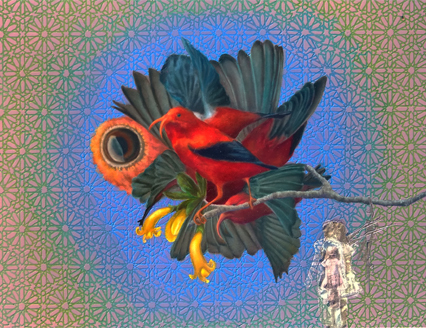
Land and People asks protectors of our vanishing, native places what they do every day to protect the places they love. We explore the common bonds and different approaches in our intimate portraits with the people of Hawai`i and the Pacific.